Custom enterprise software · 2021
HR management for small and mid-sized businesses — deadlines and headcount
A narrow HR system for small and mid-sized businesses: employees, departments, roles and projects, reminders for probation end and contract expiry, and onboarding, leaving and headcount statistics generated from the records.
The situation
Small and mid-sized companies ask for an HR system and usually end up with more than they will use. The brief here was deliberately narrow: employees, departments, roles and projects, reminders for probation endings and contract expiries, and statistics on joining, leaving and headcount.
The companies in question do not have an HR department maintaining software for its own sake. They have a manager or an administrator who does HR alongside another job, and who will stop maintaining a system the moment it costs more time than it saves.
The call we made
Build the two things that cause work when they are missed, and keep the rest minimal.
What an SME actually has is deadlines with contractual or legal consequences: a probation period that must be confirmed or ended, and a contract that expires and must be renewed or terminated. Missing either creates a problem that no amount of employee-record completeness prevents. So the reminder is the product; the employee record is the substrate that makes the reminder possible.
That decision set the scope. Employee, department, role and project data are captured because the reminders and the statistics need them, and the system stops there rather than growing appraisal, payroll and recruitment modules that the customer would have to maintain without anyone to maintain them. A narrow system that is current beats a complete system that is abandoned after the first quarter, and for this size of customer that trade is the whole design.
The same argument applies to statistics. If headcount is a query over maintained data, the monthly report is a by-product. If it is a spreadsheet compiled separately, it drifts from the records from the first month, and two people end up defending two different numbers in the same meeting.
Roles and projects were kept as light dimensions rather than as modules: they exist so that a person can be assigned and so that headcount can be cut that way, not so that the company can run a project-management practice inside its HR tool.
What we built
- Employee records with department, role and project assignment.
- Department structure and role definitions, maintained by the administrator rather than by a consultant.
- Probation-end and contract-expiry reminders, raised from the dates on the employee record.
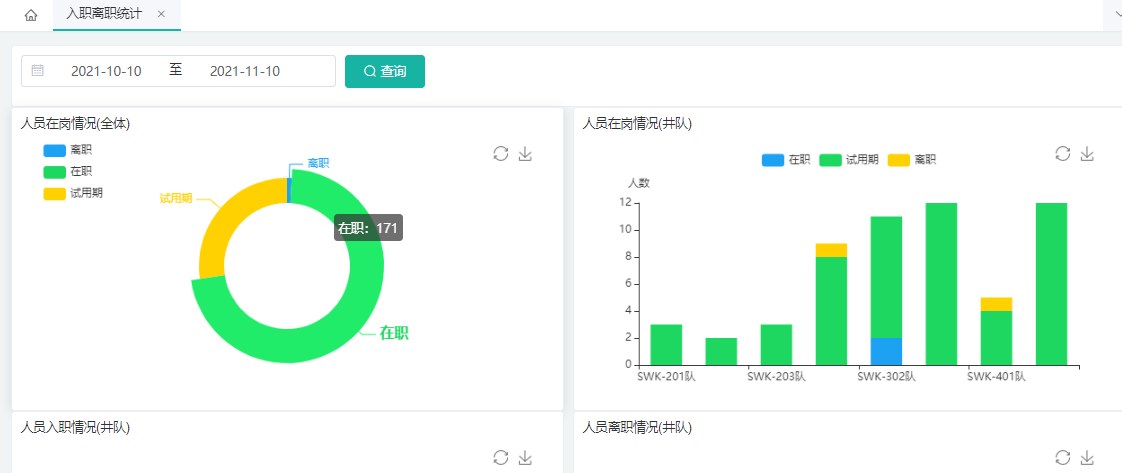
- Onboarding, leaving and headcount statistics by department, generated from the same records.
- Search and filtering over the employee list, which is the function people use most.
Result
The company gets its reminders without employing somebody to watch a calendar, and its headcount numbers without a monthly spreadsheet exercise. Onboarding and departures are recorded once, and the statistics follow.
Because the scope stayed narrow, the system is small enough that the company can keep it accurate. That is the unglamorous result that matters here: for this size of customer, a system that is used is worth more than a system that is complete.
If you are an SME buying HR software, the question is not which suite has the most modules. It is which deadlines you are currently missing, and whether the tool you buy will make those impossible to miss.
Technology
| Stack | Vue 3 · Spring Boot · MySQL · ECharts |
|---|---|
| Delivery model | Custom web application |
| Client | Small and mid-sized business clients |
| Status | Delivered |
What we cannot show
Employee records and departmental data are not published. The screen shown is from the delivered system with names and figures removed.
Similar problem?
If this looks like something you are dealing with — a legacy system that must keep running, a workflow no product covers, an integration nobody wants to touch — send a short description. We will tell you honestly whether we are the right team, and what the first two weeks would look like.